
Active Source Support
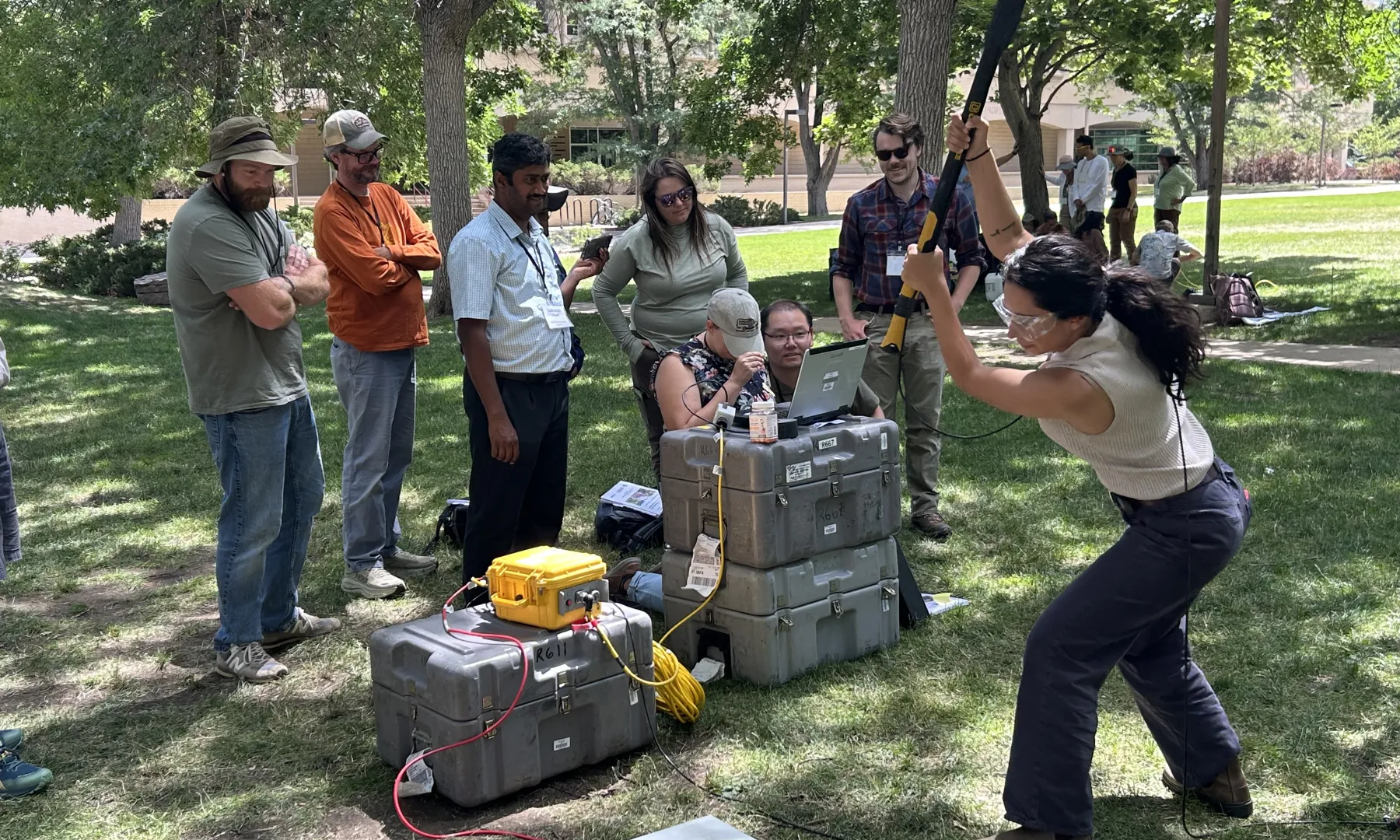
In order to collect seismological waveform data, a vibratory source and a seismograph sensitive to those vibrations are needed. These are commonly referred to as sources and receivers. In natural source seismology, receivers are deployed where seismologists think appropriate and sources are provided by nature. In controlled, or active source seismology, sources and receivers are deployed when and where seismologists need them. There are of course limitations in the size and location of sources, as well as the location of receivers, but there is no waiting for nature to provide the exact source needed. Hence controlled source seismology has many advantages in exploring the shallower parts of the Earth down to the Moho.
These seismic sources range from shotgun blanks fired into the ground, to accelerated weight drop, to small explosive charges in shallow holes, to one or more vibrators of various sizes shaking the ground, to larger explosive charges in deeper holes.
We offer technical resources for the management of active-source seismic projects, providing end-to-end seismic source capabilities for Principal Investigators (PIs). We focus on four main objectives: seismic source management, training, liability insurance, and proposal support. We provide resources to geoscientists in the fundamentals of seismic source management (experiment design, permitting, contracting, engineering and firing of sources). Liability insurance coverage is provided for projects under direct supervision. Experiment support (personnel) will determined on project needs. Currently, NSF funded projects are not requiring cost recovery of personnel time.
Ready to request instruments?
Services
Project Design and Engineering
Project designs are based on objectives. What do you want to image? How deep do you want to image? What is the geology (near surface and deeper)? The answers to questions like these will help in designing source/receiver location, source sizes and price to best meet objectives.
Cost management
Controlling costs in active source experiments is critical, costs can easily spiral out of control. This is because most drillers, blasters, and explosives vendors are accustomed to charging for their work by the hour, while grants have fixed budgets. We controls costs by contracting for services delivered at a fixed rate and tightly managing hourly work. We also provide many services ourselves, which would be prohibitively expensive if purchased from local suppliers.
Permitting
Permitting receiver/sources for active-source projects can at times be a difficult and time-consuming process. We can take over the process or even help. Our supervised projects will include liability coverage described below. This insurance can aid in the permit process by letting landowners and regulatory personnel know we are fiscally responsible and they would not need to sue the university in case of an incident.
Insurance
Increasingly, landowners are requiring seismologists and other scientists to have liability insurance when working on their property, this is true for a variety of activities. We carry a $1,000,000 commercial general liability policy that includes coverage for the use of explosives as well as other activities.
Contracting
We can contract drilling services, explosives, vibroseis, and just about anything related to active-source seismic projects from start to finish, including cleanup.
Field support
Some projects require field support. Small projects may allow field support in the form of training. Further approval may be required. Support for actual experiments is through collaborative proposals or subcontracts.
Training
We can provide training on equipment and field work. Expenses are paid from PI funding.
Facility inventory
The current inventory includes 1 powder truck (Ford F-350 4X4, with crane and type 3 explosive combination box), 1 20′ tandem axle trailer with 2 type 2 and 2 type 5 explosive magazines (all signs and placards included), 6 shooting systems (4 Joule), 3 Verif-i GPS synchronizers (timing devices), 1 Betsy Buffalo Gun (8 and 12 Ga. chambers), 1 Little Beaver auger drill ( HP), 1 TEI rock drill, and 3-channel nodes. We can contract other equipment based on experiment needs.