
Cloud Data Systems
Cloud Data Systems
The EarthScope-operated data systems of the NSF National Geophysical Facility are migrating to cloud services. With this transition comes new capabilities for users to use cloud computing for their own work, which will now be an incredibly powerful and efficient way to access these data archives.
We want to help those in the community who would like to learn the skills to take full advantage of cloud computing — an effort we call the Cloud On-Ramp. That includes both development of new tools and informational resources. In addition to the work on the data archives, a Jupyter-based notebook hub called GeoLab provides an entry point for data discovery and cloud workflows, as well as to facilitate training. Technical courses, tutorials, and documentation are being created to help you get started.
You can join our mailing lists for announcements and releases. We will be soliciting feedback along the way but if you have any questions now, contact us and ask.
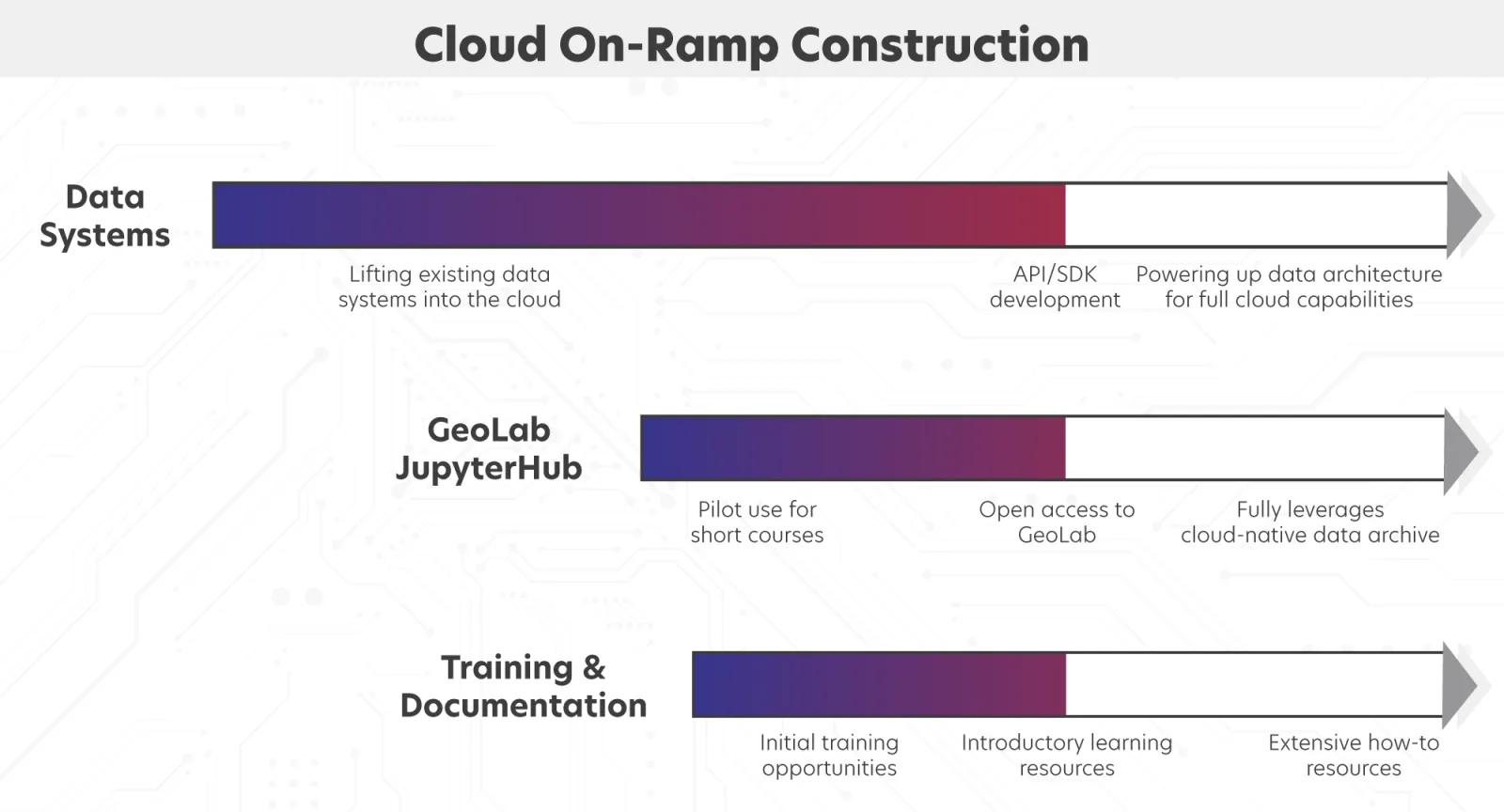
Here's where we are currently in the on-ramp effort, and what we're heading towards. We have a short video expanding on this graphic here.
News updates
- Nov. 26, 2023 Cloud data operations: an update on our progress
- Feb. 27, 2024 Cloud computing, data access, software questions… ask the Data Help Desk!
- Apr. 11, 2024 With computational notebooks, code can tell a story
- May 28, 2024 SSA meeting recap: Harnessing the power of cloud computing
- June 3, 2024 Cloud case study: a seismic processing tutorial for your first foray
- July 29, 2024 A successful run for the first short course in the GeoLab notebook hub
- September 17, 2024 Pancakes are the future of geophysical data processing
- October 23, 2024 Cloud case study: Using DAS to listen to glacial meltwater streams
- November 26, 2024 Meet TileDB―one key to optimizing our data archives
- February 27, 2025 Cloud 101 short course at 2025 NSF GAGE/SAGE Community Science Workshop
- April 22, 2025 Cloud case study: Separating GNSS slow slip signals from noise
- June 9, 2025 Cloud computing at the Community Science Workshop
- July 3, 2025 Cloud case study: Mining the seismic archive for a new earthquake catalog
- September 15, 2025 An overview of cloud computing in the petabyte era of seismology
- February 18, 2026 A conversation with a NASA data effort to support research in the cloud
- April 30, 2026 GeoLab cloud compute hub opening to all users in June
- June 9, 2026 GeoLab cloud compute hub now open to all users
- August 5, 2026 Increased resource availability in GeoLab
- August 12, 2026 GeoLab hosts CRESCENT short course on strain accumulation from GNSS
- September 10, 2026 From RINEX files to cloud-native data access: GNSS reflectometry with our SDK
- September 26, 2026 MsPASS course’s third run in GeoLab underlines development
Frequently Asked Questions
Will I still be able to download data as I have in the past?
Yes, your existing workflows will not be interrupted. The use of cloud computing is simply an additional option that can benefit from our new cloud-optimized data architecture.
Are these new cloud capabilities available now?
While many data systems have migrated to cloud operations, the new capabilities we're talking about are not yet available—see the "Cloud On-Ramp Construction" graphic above.
Will I have to create and manage my own cloud environment?
We are hosting a notebook hub (GeoLab) for the community to use at no cost, which will support exploration, prototyping, and small scale data analysis. For very large data analysis workflows (those not composable in a notebook, etc.), a dedicated cloud environment might be necessary and we will help researchers navigate this option.